 Read Markdown
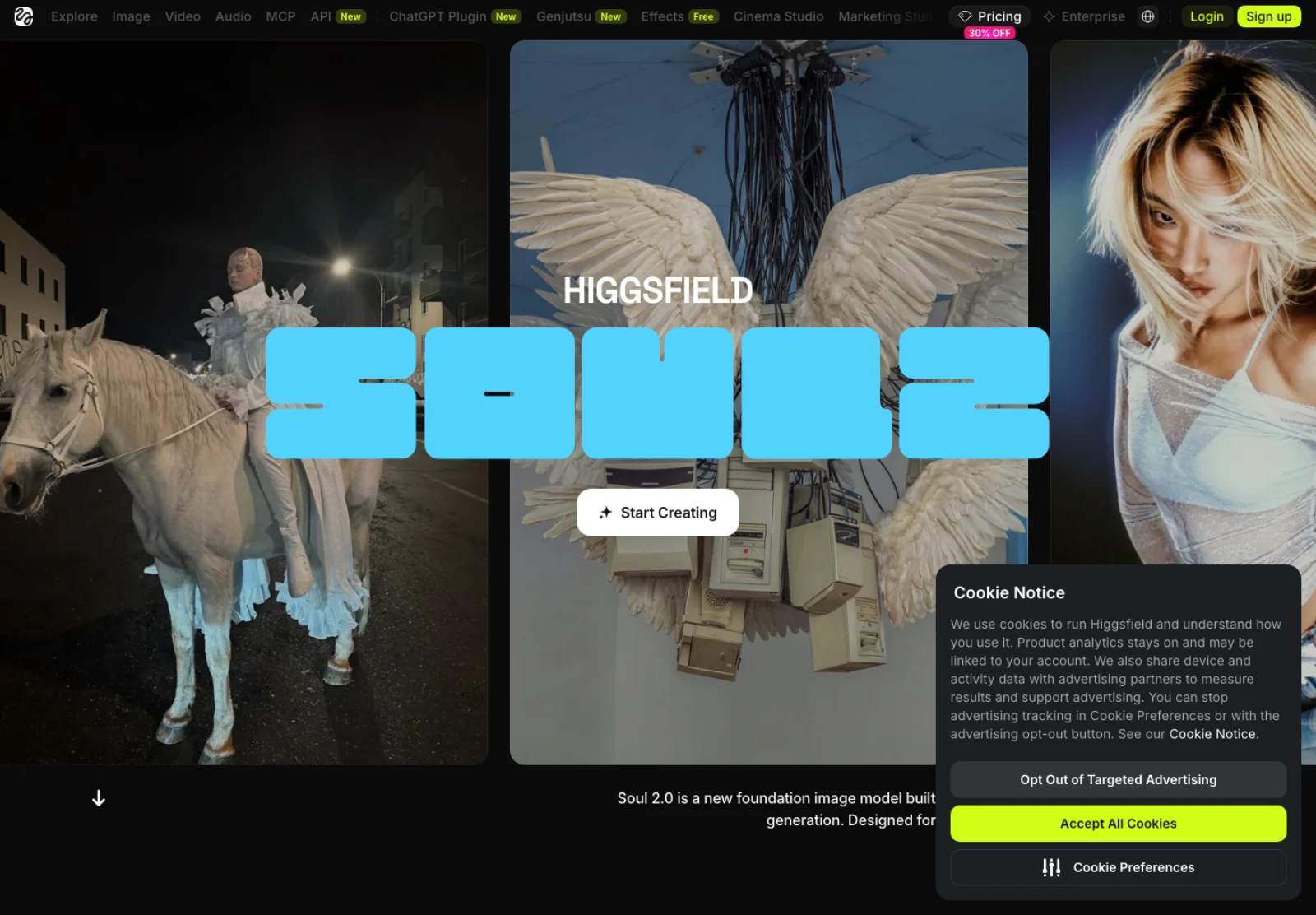
Higgsfield is not one video generator. It is a subscription that fronts roughly a dozen third-party video and image models, wraps its own image model (Soul) and its own filmmaking workspace (Cinema Studio) around them, and then keeps adding studios for ads, storyboards, character swaps, agents and plugins. If you want one place to try Kling, Seedance, Veo and Wan side by side and you make short cinematic or social clips, it is the most complete such place in September 2026. If you want a project you can keep editing, or you dislike credit accounting, it will frustrate you. The rest of this post is the detail behind that sentence, current as of 17 September 2026 and sourced to Higgsfield's own pages, its changelog and attributed user reports.
Jump to: what it is · glossary · models · getting started · limits · what users say · verdict
What Higgsfield is
Higgsfield AI was founded in 2023 by Alex Mashrabov, who previously ran generative AI at Snap after selling his startup AI Factory to it, and AI researcher Erzat Dulat. Most of the engineering team is in Kazakhstan, and the company became that country's first unicorn in September 2025 (Kursiv). Its about page says it is headquartered in San Francisco and claims more than 25 million users and 850 million generations (Higgsfield).
The money has moved fast. An $80 million Series A extension in January 2026 valued the company above $1.3 billion, and a $400 million Series B led by DST Global in August 2026 took that to $5.4 billion, with Higgsfield reporting $700 million in annualised revenue and 30 million users at the time (TechCrunch). Those are the company's own figures, repeated by the press rather than audited.
The positioning is "multi-model platform plus its own tools". Higgsfield licenses the big video models and sells access to all of them under one plan, then differentiates with things the model vendors do not ship: Soul for stills, Cinema Studio for camera and lighting control, and a growing set of studios for specific jobs. That structure is why the product is hard to summarise and why the glossary below exists. If you are choosing between it and a single-vendor tool, the Higgsfield vs Runway comparison covers that question directly.
Every surface, what it does, and what runs it
Higgsfield names its features generously, and several of them are the same capability reached from different doors. This table is the map. "Plan gate" reflects the help center's rule that credits apply everywhere, and that Unlimited access and free generation pools apply only on higgsfield.ai, not in plugins, MCP or Supercomputer (integrations).
| Surface | What it does | Models behind it | Plan gate |
|---|---|---|---|
| Soul, Soul 2.0, Soul Cinema | Photorealistic stills with 50+ style presets; 2.0 adds Moodboards, Soul ID characters and Soul HEX palettes; Cinema is the film-look variant | Higgsfield's own Soul family; Soul 2.0 released 17 February 2026 | Credits; Plus and Ultra carry free Soul V2 and Cinema pools |
| Cinema Studio 2.0 to 4.0 | Filmmaking workspace: camera body, lens, aperture, movement presets, genre, era, tempo, lighting, colour palettes, emotion control, multi-shot and extend | 4.0 runs on Seedance 2.5; earlier versions on native Cinema Studio models | Credits unless the Cinema Studio models are in your plan's Unlimited list |
| Popcorn | Storyboards: one prompt or up to 4 references expanded into up to 8 consistent frames, Manual or Auto mode, plus Instadump for styled photo packs | Not named on the help page | Credits, cost shown on the button |
| Motion Control | Transfers movement and expression from a reference video onto a character image | Kling Motion Control, upgraded to 3.0 on 5 March 2026 | Credits, plan dependent |
| Recast and face swap | Replaces a person in existing footage while keeping motion, lighting and scene; face and full-body variants live in the Apps catalogue | Not named on Higgsfield's pages; third-party guides say Kling | Credits |
| Genjutsu | Object swap and motion transfer on a 4 to 30 second clip with up to 30 reference images, 1080p | Not named; launched 1 September 2026 | Credits, $2 to $7.20 per generation at Higgsfield's stated rates |
| Marketing Studio, Click to Ad, UGC | Paste a product link or upload photos, pick a template (product shot, UGC, ad, poster, motion graphic, marketplace image), get publish-ready assets; 100+ avatars | Mix of platform image and video models | Credits, even on Unlimited plans |
| Influencer Studio | Build a consistent AI character (Soul ID trains on 20+ photos) and generate content around it | Soul 2.0 plus video models | Credits |
| Supercomputer | Agent workspace that plans, picks models and renders; text is free in Free Mode; generation is credits | Claude Fable 5.1 (3 September), GPT-6 Astra (4 September), GLM-5.3 Flash and others | Credits, no Unlimited |
| Apps and marketplace | No-code generative apps built in chat and published to a URL; 500+ in the catalogue; users spend their own credits | Any platform model the app calls | Credits |
| Faceless Studio, Explainer, Shorts Studio, 3D Jutsu, Gaming, Layers, Relight, Colour Palette | Standalone spin-offs of skills or tools, each a narrower workflow | Various; Shorts Studio uses Gemini Omni Flash | Credits |
| Plugins: Premiere Pro, After Effects, Photoshop, DaVinci Resolve, Figma, Blender, Minecraft | Generation, reframe, background removal, upscale, edit video and similar, inside the host app | Same models as the web | Credits at web rates; no Unlimited in plugins |
| MCP and API | Generation from Claude, Cursor, ChatGPT or your own code; the After Effects Motion Designer runs through GPT | Same models | Credits |
| Mobile | Higgsfield, Inc. publishes iOS apps under its own developer account; the help center's integrations page does not describe a mobile app | Unknown | Unknown |
A few notes the table cannot hold.
Soul and Moodboards. Soul is the reason many people arrive. It is a stills model tuned for fashion and editorial looks, with presets grouped as General, TikTok Core, Instagram Aesthetics, Beauty, Mood, Camera Photo and Graphic Art, output at 1.5K or 2K, batches of 1 to 4 (help center). A Moodboard is a reusable style built from your own references: upload up to 80 images that share one look, 20 to 30 recommended and ideally without faces, and Soul 2.0 derives a preset from their lighting, texture and colour (Moodboards guide). Moodboards, Soul ID and Soul HEX stack in one generation. Attach a reference image, though, and the prompt field goes away.
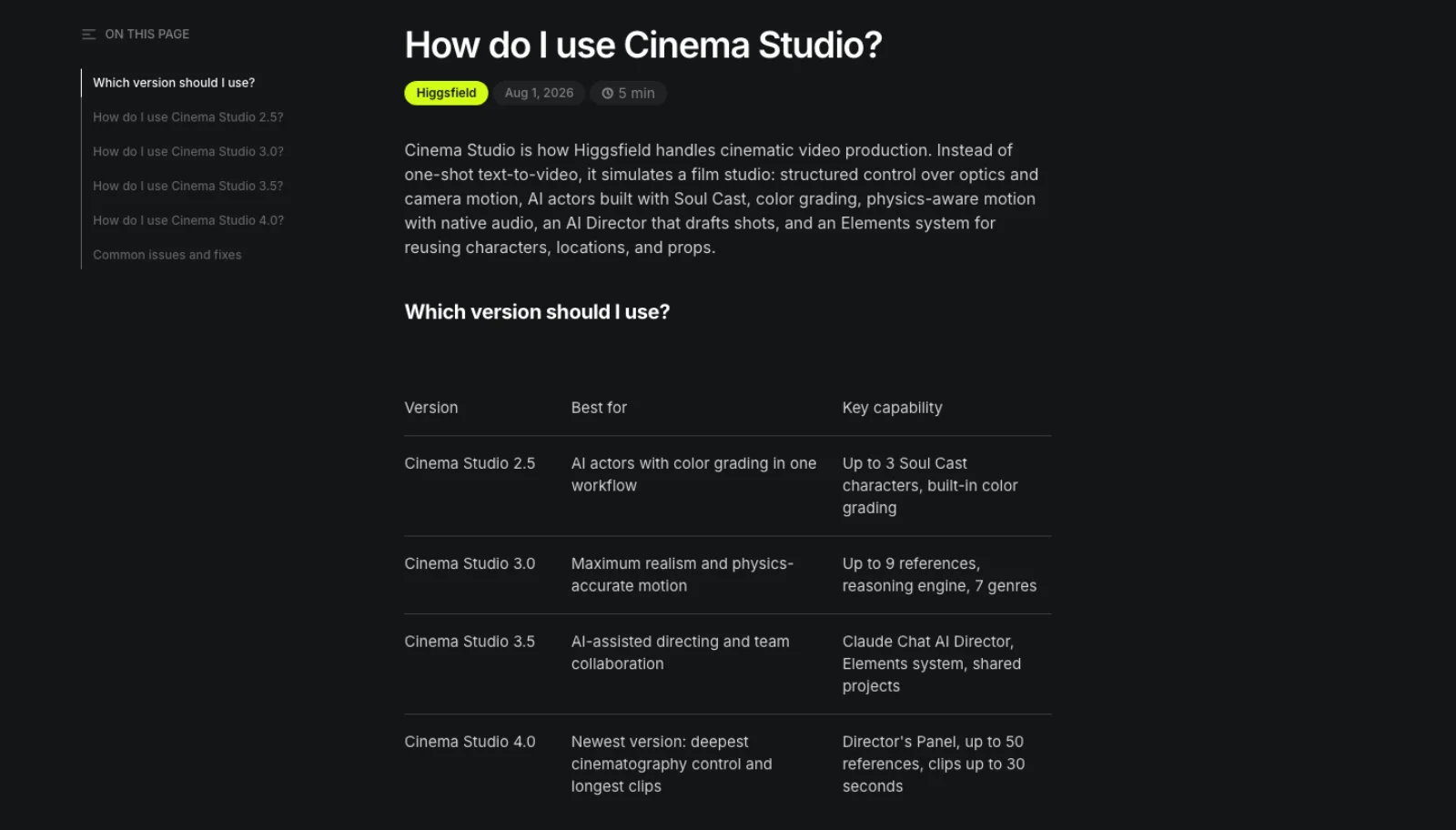
Cinema Studio is four products under one name. The version selector at the top switches between 2.0 (1 to 12 second shots, 1080p, genre motion logic), 2.5 (Soul Cast actors and a colour-grade panel), 3.0 (up to 9 references and a reasoning engine that skips manual start and end frames), 3.5 (per-shot camera, lens, focal length and aperture, project-wide style, an Elements library, and a Claude chat director that fills the prompt box but never triggers generation) and 4.0, released 12 August 2026, which runs on Seedance 2.5 with up to 50 references and 30 second clips, a Director's Panel with four camera bodies, five lenses, 30+ movement presets, 50+ colour palettes, an eight-emotion wheel, an era selector from the 1960s to the 2020s and Forward/Backward Extend on an uploaded clip (help center, 4.0 announcement). When someone says "Cinema Studio", ask which version.
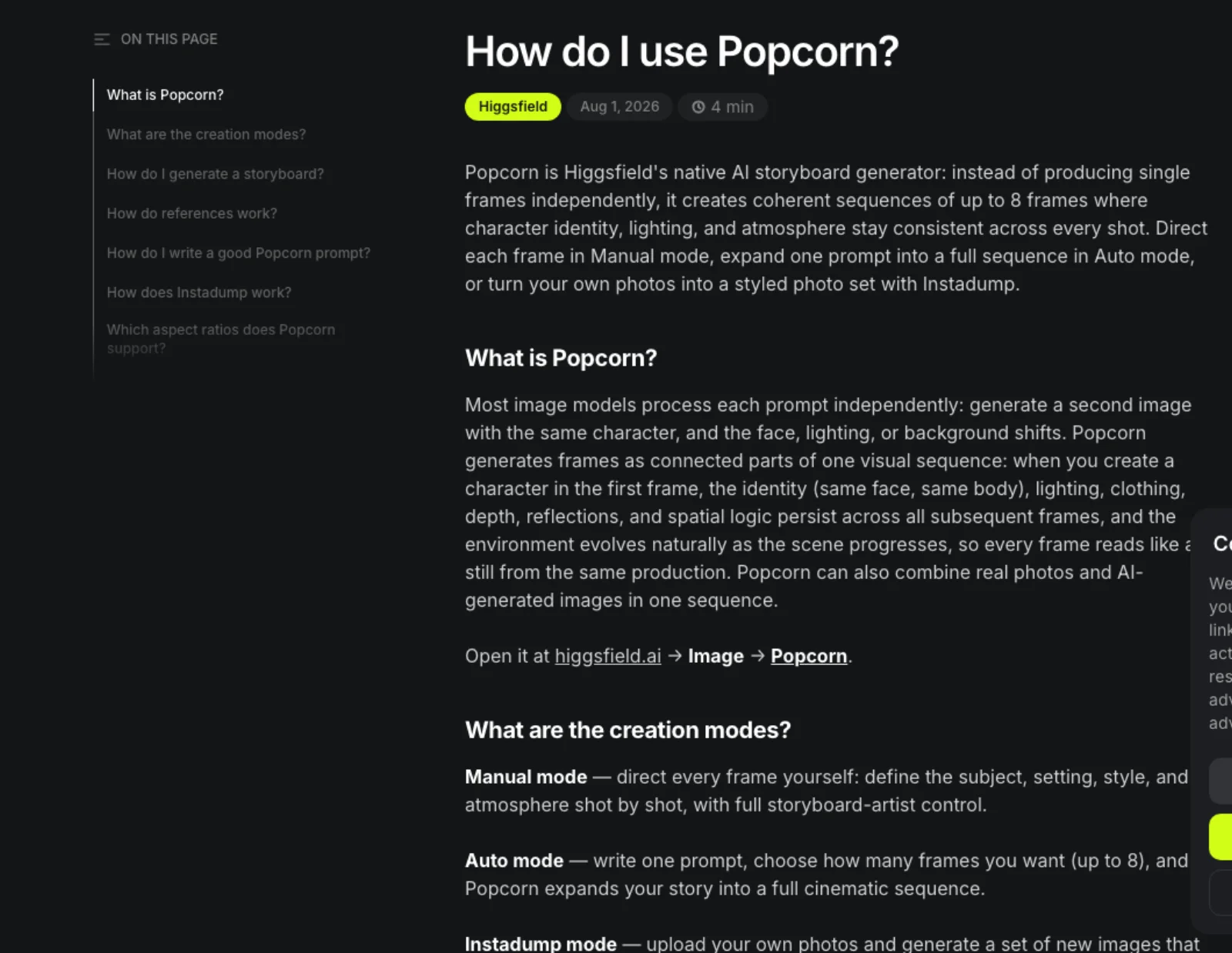
Popcorn is the storyboard tool. It takes a prompt, up to four reference images or both, and returns four, six or eight frames that hold character, lighting and depth across the sequence; individual frames can be edited and regenerated without breaking the set (help center). Higgsfield's posts about it date from October 2025.
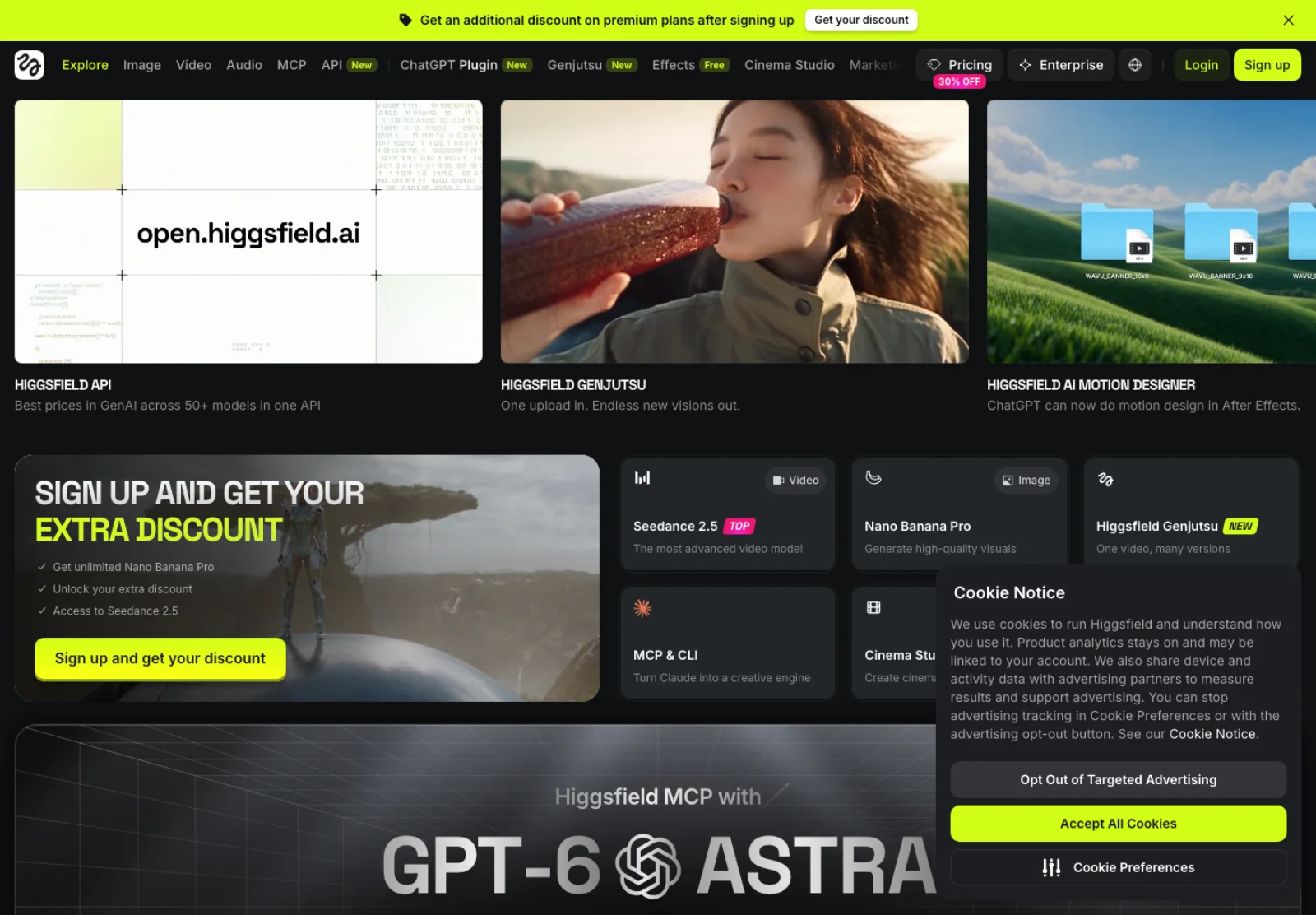
Supercomputer and Apps are where the company is spending its attention. Supercomputer is an agent chat that plans a job, picks models, and renders; the company says it built its own harness rather than adopting a general agent, and that skills encode how each model should be prompted (Inside Higgsfield). Apps, launched in July 2026, lets anyone describe a generative app in chat and publish it; the person using the app signs in and spends their own credits (Apps launch). The plugins and MCP are covered in detail in Higgsfield MCP.
The third-party models on 17 September 2026
This is the list that changes most often. Dates come from Higgsfield's changelog and model posts; durations are the maximum a single generation will produce on the platform, as stated by Higgsfield (changelog, model comparison).
| Model | On Higgsfield since | Max per generation | Notes |
|---|---|---|---|
| Seedance 2.5 | 6 August 2026; 1080p early access 14 August | 30 seconds at 480p, 720p or 1080p, 4K by upscale | Up to 50 references, region-level edits, native audio; 10 seconds at 720p listed at 65 credits (Seedance 2.5 post) |
| Seedance 2.0 and 2.0 Mini | 3 April 2026; Mini 21 June | 15 seconds; 4K option since 21 June | Native audio; the most common Unlimited video model on higher tiers |
| Kling 3.0 and 3.0 Turbo | Turbo 15 June 2026 | 15 seconds, up to 4K | Up to 6 camera cuts in one generation, Omni native audio (Kling 3.0 page) |
| Kling 2.6 and Kling o1 | Earlier in 2026 | 15 seconds | 2.6 is the Motion Control base; o1 is the reasoning variant |
| Veo 3.1 | 2026 | Not stated on Higgsfield's pages | Native audio; 1080p in Higgsfield's own timing test |
| Sora 2 | 2026 | Not stated | OpenAI retires the Sora API on 24 September 2026, one week after this post; expect it to leave the picker (OpenAI) |
| Wan 2.7 | 2026 | 15 seconds | Video-reference style transfer, lip sync |
| Wan 3.0 and 3.0 Prime | 24 August 2026 | 30 seconds | Multi-subject consistency |
| MiniMax Hailuo 2.3 and H3 Max | H3 Max 31 August 2026 | Not stated; H3 Max up to 768p | Fast mode |
| Gemini Omni 1.1 Flash | 28 August 2026 (Flash preview 30 June) | Not stated | First and last frame control, 360p draft mode |
| Grok Video 1.5 | 2 June 2026 | Not stated | Still-image animation |
Image models follow the same pattern: Nano Banana Pro, Nano Banana 2 and 2 Lite, GPT Image 2.5, Seedream 5.0 Pro (7 July), Recraft V4 and V4.1 (27 August), Flux.2 Pro, Kling o1 Image, alongside Soul. Audio arrived as Seed Audio 1.0 on 25 June and a Qwen-based redesign on 10 August. The practical reading: on the day of writing, the 30 second ceiling belongs to Seedance 2.5 and Wan 3.0, everything else Higgsfield documents stops at 15 seconds, and Sora 2 is about to go.
Getting started: a walkthrough from the help center
This section is built from Higgsfield's own help articles and product pages, not from a hands-on session, so treat button names as approximate where the interface has moved.
- Account and plan. Sign up at higgsfield.ai with email or a social login. Free accounts exist and every generation on one carries a visible watermark; the only way to remove it is any paid plan, and upgrading does not clean files you already made (watermark policy). Whether a free account currently receives any credits is contested: third-party trackers in September 2026 report either a small daily allowance or none, and Higgsfield's pricing cards do not advertise one.
- Credits. Every generation shows its credit cost on the Generate button before you confirm. Monthly credits reset with the billing cycle; Unlimited windows on specific models bypass credits on the web only. The pricing section below has the numbers.
- First image. Top navigation, Image, then Soul 2.0. Pick a preset, write a prompt, set aspect ratio (9:16 through 16:9), quality (1.5K or 2K) and batch size (1 to 4), Generate. Output lands in the tool and in Assets (first generation).
- A Moodboard. In Soul 2.0, open the Moodboard icon, upload 20 or more references in one coherent style from your device or Assets, let it process, then select it alongside a prompt, a Soul ID or a HEX palette.
- First image to video. Video in the top navigation, choose a model (Seedance 2.5 or Kling 3.0 are the current defaults for quality), attach the still as a reference or as a first frame, set duration and resolution, Generate. Higgsfield's own timing test puts an 8 second Kling clip at about 90 seconds end to end at 720p and about three minutes at 1080p, and Seedance at 720p around three and a half to four minutes (generation times).
- Cinema Studio instead. If you want camera and lighting control rather than a bare prompt, open Cinema Studio, leave it on 4.0, add references with the picker, set genre, era, tempo, camera body, lens, aperture and lighting in the Director's Panel, then generate up to 30 seconds.
- Extending. In Cinema Studio 4.0, switch the video mode to Forward or Backward Extend and upload the clip you want continued (input up to 30 seconds). Edit Video mode makes regional changes without a full regeneration. Outside Cinema Studio, Genjutsu handles object swaps and motion transfer on an existing clip.
- Exporting. Download from Assets as a video file. There is no project or timeline export; if you edit elsewhere, the plugins for Premiere, After Effects and Resolve place generated clips onto your timeline (Resolve 19 or newer; Premiere and After Effects 24.0 or newer per the help center's integrations page, 25.0 per the plugin download page) (Resolve plugin).
Quality, limits and wait times
Duration. Per generation, 30 seconds on Seedance 2.5, Wan 3.0 and Cinema Studio 4.0; 15 seconds on Kling 3.0, Seedance 2.0 and Wan 2.7; 12 seconds total on Cinema Studio 2.0. Longer pieces are sequences of clips, which Higgsfield's Cinema Studio and its long-video landing page describe as stitching shots rather than one continuous generation.
Resolution. Seedance 2.5 renders at up to 1080p with 4K as an upscale step; Kling 3.0 and Seedance 2.0 offer 4K options; Soul stills are 1.5K or 2K. Higgsfield's own numbers show 1080p costing roughly 2.5 times the render time of 720p on Kling.
Wait times. Higgsfield's July 2026 test measured queue at 3 to 34 seconds and total time from 90 seconds to four minutes for 8 second clips. User reports differ. A third-party guide compiled from Trustpilot reviews around December 2025 describes paid Unlimited users waiting 30 to 40 minutes on Nano Banana Pro while trial accounts went faster, and a pattern of speed dropping over the course of a billing month (Multic). Higgsfield's own plan comparison says standard queue mode runs one video or two images at a time, and the help center sells extra concurrency as a Concurrency Boost (Higgsfield). Treat Higgsfield's timing figures as a floor.
Watermarks and rights. Free output is watermarked. You own what you generate on every plan and can use it commercially without an extra licence; content on non-enterprise plans may be used for training unless you delete it (ownership).
Content checks. Cinema Studio 3.0 and later block real faces and protected IP with a "May contain protected content" message, so Recast and Motion Control work on your own footage and your own consenting subjects, not on film clips.
Pricing in one paragraph
Higgsfield's own plan post, verified 11 September 2026, lists Starter at $15 a month, Plus at $49 a month or $39 on annual, and Ultra at $129 a month or $99 on annual, with Plus and Ultra carrying a 365-day Unlimited set of six image models, free Soul V2 and Cinema pools of 3,000 to 10,000 generations, and seven-day windows on flagship models such as Nano Banana Pro and, on annual Ultra, Kling 3.0 (Higgsfield). Third-party checks the same week quote different Starter and Plus prices and credit counts, and the site runs frequent promotions, so the checkout is the only reliable source. Marketplace passes sell 1, 3 or 7 days of Unlimited on single models from $7. Unlimited applies on the website only; plugins, MCP, Supercomputer and Marketing Studio always bill credits. The full breakdown, including what a credit buys on each model, is in Higgsfield pricing.
What users praise and what they complain about
Reddit was not reachable from where this post was written, so the sources here are review sites and one forum, each with counts and dates.
Trustpilot, 17 September 2026. 4.0 out of 5 from 4,441 reviews, 4,317 of them in the last twelve months, split 62 percent five-star and 19 percent one-star (Trustpilot). The five-star reviews are short and repeat three things: many tools in one place, the cinematic camera moves, and responsive support. The one-star reviews repeat three others: credits that expire or vanish at renewal, subscription terms and checkout defaults that people felt were unclear, and failed generations that still cost credits. Three reviews dated 17 September illustrate the spread: one commends support, another from a self-described SaaS veteran calls the interface confusing and reports poor text rendering, and a third reports more than $800 spent on video attempts with language errors.
G2. 4.5 out of 5 across 79 reviews on the seller page as of this week (G2), skewed toward marketers who like the template studios.
Blind. A single March post titled "higgsfield is a total bait and switch" alleges that Unlimited plans were throttled by a "battery" mechanism and that heavy users were banned; it drew one reply (Blind). One post is one post, but the throttling claim matches the queue reports above.
What the praise and the complaints have in common is that they are both about the wrapper, not the models. Nobody argues that Seedance or Kling look worse on Higgsfield than elsewhere. The disputes are about how access is metered and how the queue behaves under load.
What you get back, and how editable it is
Everything Higgsfield produces comes back as a rendered file: a still, or a video with its audio baked in. Within the platform there is more re-work available than a plain generator offers. Cinema Studio 4.0 and Seedance 2.5 support regional edits and forward or backward extension of a clip; Popcorn lets you regenerate one frame of a storyboard while the others hold; Genjutsu and Recast rewrite part of an existing clip; the Relight and Colour Palette tools adjust a finished video; and the Reframe tool in the plugins produces new aspect ratios generatively. What does not exist is a project. There is no timeline export, no separate audio stems, no captions as text, and the prompt and references behind a clip are recoverable only inside Higgsfield's own history. Every future change goes back through the platform or into an editor as footage. The four questions in what editable should mean for AI video apply here: Higgsfield answers the first one partially and the other three no.
Who it is for, and who should look elsewhere
It fits people who make short clips and stills for social, ads or previsualisation, who want to compare models without holding four subscriptions, who value camera and lighting presets over prompt craft, and who will use enough volume that an Unlimited window pays for itself.
It fits less well if you need a single model's newest features the day they ship from the vendor (Higgsfield is usually days to weeks behind, and some features arrive only through the vendor's own app), if your work is longer than 30 seconds in one continuous take, if you finish in an editor and want a project rather than clips, or if you find credit and window accounting exhausting. For those cases, Higgsfield alternatives sorts fourteen options by the job, and OpenArt vs Higgsfield covers the closest like-for-like rival.
Verdict by job
| Job | Verdict | Why |
|---|---|---|
| Cinematic 10 to 30 second shots with camera control | Strong | Cinema Studio 4.0 on Seedance 2.5 is the deepest control surface on any hosted generator today |
| Comparing Kling, Seedance, Veo and Wan on one prompt | Strong | One picker, one credit pool; Sora 2 leaves on 24 September |
| Fashion and editorial stills, consistent characters | Strong | Soul 2.0 with Moodboards, Soul ID and HEX is the reason many people subscribe |
| Storyboards from a script | Good | Popcorn holds identity and lighting across up to 8 frames; export is images, not a shot list you can round-trip |
| Product ads and UGC at volume | Good, credits only | Marketing Studio and Click to Ad are fast; nothing here is ever Unlimited |
| Character or face replacement in your own footage | Good, with limits | Recast, Motion Control and Genjutsu work on short clips (Genjutsu 4 to 30 seconds); protected faces are blocked |
| Motion graphics in After Effects | Promising, early | Motion Designer writes editable layers through GPT; needs three subscriptions |
| Anything longer than 30 seconds in one take | Weak | Sequence and stitch; no model on the platform goes further |
| Work you will revise for weeks | Weak | Rendered files, no project export |
| Predictable monthly cost | Mixed | Unlimited windows are real on the web, and credits still run out on everything else |
Frequently asked questions
What is Higgsfield AI? A San Francisco and Kazakhstan company, founded in 2023, that sells one subscription for a dozen third-party video and image models plus its own tools: the Soul image model, the Cinema Studio filmmaking workspace, Popcorn storyboards, Motion Control, Recast, Marketing Studio, the Supercomputer agent, an apps marketplace and plugins for Adobe, Resolve, Figma and Blender. It raised $400 million at a $5.4 billion valuation in August 2026.
Is Higgsfield legit? Yes, in the sense of being a real, funded company with a working product and 4,441 Trustpilot reviews averaging 4.0. The complaints are about billing clarity, credit expiry and queue times on Unlimited plans, not about the product failing to generate. Read the plan terms before paying and check the checkout for annual defaults.
Is Higgsfield free? There is a free account, and its output is watermarked. Whether it comes with any credits changes with promotions; Higgsfield's pricing cards do not advertise a free allowance as of September 2026. Paid plans start at $15 a month by Higgsfield's own post. See Higgsfield pricing.
What is Higgsfield Soul? Higgsfield's own image model, tuned for fashion and editorial realism. Soul 2.0, released 17 February 2026, adds Moodboards (a style learned from up to 80 of your reference images), Soul ID (a consistent character trained on 20 or more photos) and Soul HEX (a colour palette pulled from a reference). Soul Cinema is the film-look variant.
What is Cinema Studio? Higgsfield's filmmaking workspace, in versions 2.0 through 4.0 selectable at the top of the page. Version 4.0, released 12 August 2026, runs on Seedance 2.5 and adds a Director's Panel with camera bodies, lenses, aperture, movement presets, lighting, colour palettes, an emotion wheel, an era selector, up to 50 references and clips up to 30 seconds, plus extend and regional edit modes.
What is the max video length on Higgsfield? 30 seconds in a single generation, on Seedance 2.5, Wan 3.0 or Cinema Studio 4.0. Kling 3.0, Seedance 2.0 and Wan 2.7 stop at 15 seconds. Longer videos are built by sequencing clips.
Make your next project in Voyager
Create an account, download Voyager, and start making.